Showing posts with label Around the World in Eighty Days. Show all posts

Monday, March 30, 2009

Ending (1)


“Phileas Fogg had won his wager, and had made his journey around the world in eighty days. What had he really gained by all this trouble? What had he brought back from this long and weary journey? Nothing, say you? Perhaps so, nothing but a charming woman, who, strange as it may appear, made him the happiest of men.”(Verne 245).

I did not really like the last chapter of the novel, because the story suddenly ended without any clarifications and solutions. When detective Fix found out that the actual robber was caught three days ago, Fogg is released from prison, and he suddenly finds out that he had actually made it back to England in time. I felt that the ending came too sudden, following Fogg and Aouda’s decision to get married the next day. Furthermore, I felt that the ending was unclear, because the International Date Line explanation was did not really make sense. Because the author forgot to take account of the first time the characters crossed the Pacific, it seemed unclear as to how long the journey had actually taken place. I am expecting that the author was trying to end the novel with a happy ending, and that is why he decided to end the story so suddenly by making Fogg win the bet.

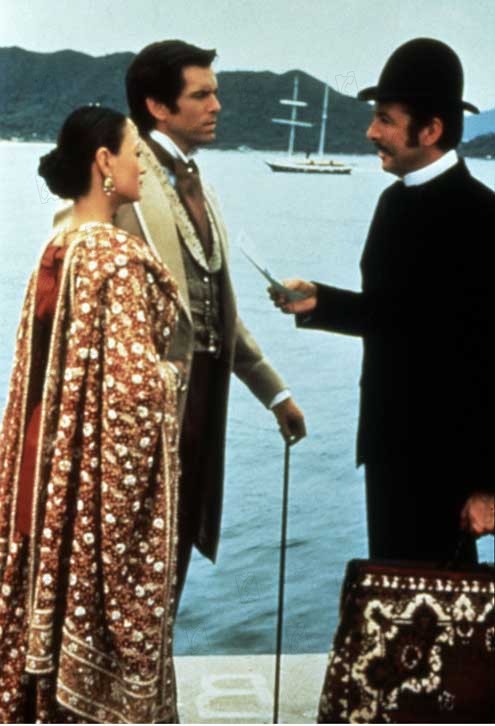
Aouda


Before: “You are four minutes slow. No matter; it’s enough to mention the error. Now from this moment, twenty-nine minutes after eleven, A.M., this Wednesday, October 2nd, you are in my service.” (Verne 13)
After: “When he opened them again, I love you, he said, simply. Yes, by all that is holiest, I love you, and I am entirely yours.” (Verne 236).

In the beginning of the novel, Fogg is very cold and somewhat calculating. After meeting Aouda however, he begins to change in personality. Although I realized that Fogg had changed a lot after meeting Aouda, I was very surprised when Fogg confessed his love to her. I was also surprised by how quickly he had made the decision to marry her, agreeing to marry her the very next day. The old Phileas Fogg would have never let such things, because he required everything to be superhumanly prompt and regular.

International Date Line- 80 or 81 day? (2)


“The cause of the error is very simple. Phileas Fogg had, without suspecting it, gained one day on his journey, and this merely because he had traveled constantly eastward; he would, on the contrary, have lost a day, had he gone in the opposite direction- that is, westward.” (Verne 243).

The ending was very unclear to me. When Phileas Fogg and Passepartout left England and headed towards Hong Kong, they had initially crossed the Pacific without accounting for the International Date Line. For this reason, there is no need to “take a day away”. If the two characters had taken account of the International Date Line when they first crossed the Pacific, they would have lost a day and then gained back a day when they reached New York. Thus, this would have no effect on the date and would mean that Phileas Fogg had returned to England in 81 days. Another part I thought was confusing was how Passepartout was keeping a close eye on the date and the time. In the novel the narrator states that Passepartout kept the London time and did not bother to change his watch. “You have kept London time, which is two hours behind that of Suez. You ought to regulate your watch at noon in each country.” “I! Regulate my watch! Never!” “Well, then, it will not agree with the sun.”(Verne 44).

Symbolism of the Novel


Phileas Fogg, the main character, is a reserved and punctual Englishman. He lives a regularized life, following nothing but his daily schedule. Because of this reason, the only social life he has is at the Reform Club. After an argument with another reform club member, he is convinced that he can travel around the world within eighty days. With his valet, Passepartout, he decides to leave his home and embark a journey around the world. Although Fogg tries to follow a specific schedule, he is slowed down, visiting different places and meeting different people. Although he is limited in time and is unable to follow his regularized lifestyle, Fogg ends up gaining more from his busy life than his solitary and punctual life. Through the novel, I think the author is trying to imply that keeping everything in control can sometimes make things harder for people, because it takes away the fun. I think the author is trying to teach the audience that you should let time pass, not try to control it.

True Motives (7)


My predictions from Prompt 6 were partly incorrect. Detective Fix was not sent or paid by any member of the Reform Club. However I was right in predicting that he was trying to find the culprit so that he can get a percentage of the stolen money as an award. I was also right in predicting that Fix did not truly want to solve the case, because further in the novel the author reveals that Fix was merely pretending to go around the world to chase Phileas Fogg when his real purpose was to flee the law in England. At the end, Fix gets nothing that he wanted. When Fogg, Passepartout, Aouda, and Fix arrive in Liverpool, Fogg is arrested but set free when it is found that the actual robber was caught three days ago. So Fix ends up getting no money and is back in England, unable to free himself

Transition (3)


“The project was a bold one, full of difficulty, perhaps impracticable. Mr. Fogg was going to risk life, or at least liberty, and therefore the success of his tour. But he did not hesitate, and he found in Sir Francis Cromarty an enthusiastic ally.” (Verne 77).


In the beginning of the novel, the narrator describes Mr. Fogg as a very reserved and punctual man. He is impeccable in his manners and is described as living a regularized life. He “required to be almost superhumanly prompt and regular. On this very 2d of October he had dismissed James Forster, because that luckless youth had brought him shaving water at eighty0four degrees Fahrenheit instead of eighty-six; and he was awaiting his successor, who was due at the house between eleven and half-past” (Verne 12). Throughout the novel however, the readers see a change in Mr. Fogg’s character as he becomes more rational. For example, during the journey he comes across a young Parsi woman named Aouda, who is being dragged to a sanctuary to be sacrificed by Brhamins. When Passepartout tells him to save Aouda, he decides to devote his spare twelve hours to help free her from the sati ceremony. Due to the incident, he loses the two days that he had gained earlier but does regret it. Furthermore, he decides to take Aouda with him when he finds out that her family has moved and is no longer in Hong Kong. He feels it is uncaring just to leave her behind in Hong Kong by herself and decides to take her to England, where he can support her with his wealth.

Clues (6)


“Consul, said he, I have no longer any doubt. I have spotted my man. He passes himself off as an eccentric who is going around the world in eighty days. Send a telegram to London for a warrant of arrest to be dispatched instantly to Bombay, take passage on board the Mongolia.” (Verne 46).


From what I have read so far, detective Fix seems like a fool. Without a thorough investigation, he is suspecting that the main character, Mr. Fogg, is the bank robber. I feel that there is something about the detective, because he seems like he isn’t trying really hard to solve the case. From my perspective, it seems like he is rather trying to grab anyone that fits the description of the robber and accusing them of the crime so that he can get in recognition and possibly some money. I also think that detective Fix may have been paid to interfere in Mr. Fogg’s journey, because it is highly likely that another member from the Reform club is trying to make Fogg lose the bet.

Detective Fix and Che Guevara (10)


After reading the novel, Around the world in 80 days, I thought that detective Fix was very much alike Ernesto Guevara. When detective Fix suspects Mr. Fogg as the bank robber just by matching him to the description of the robber, I felt that Fix was acting very foolishly like Guevara was in his earlier years. Because of Fix’s mistake in suspecting Mr. Fogg as the criminal, he ends up delaying the whole voyage and makes many obstacles for Mr. Fogg, Passepartout, and Aouda. Similarly in Motorcycle Diaries, Ernesto Guevara puts his troops at risk and ends up killing himself when he tries to start another revolution in Bolivia, believing that he could become a hero and savior of the people of South America.

Jules Verne (12)


In the novel, Around the World in Eighty Days, author Jules Verne includes descriptions of various rail and shipping lines that were newly built during the technological innovations of nineteenth century. From reading the novel and after researching about the author’s history, I think the narrator might have accepted some companies’ requests to include their names and information onto the book. I would have omitted such information, because I think it distracted readers from the main plot. I feel that the author could have included more necessary information, such as a brief background history or description of the country (setting), because I think it would have helped readers follow through the novel.

Age of Exploration (8)


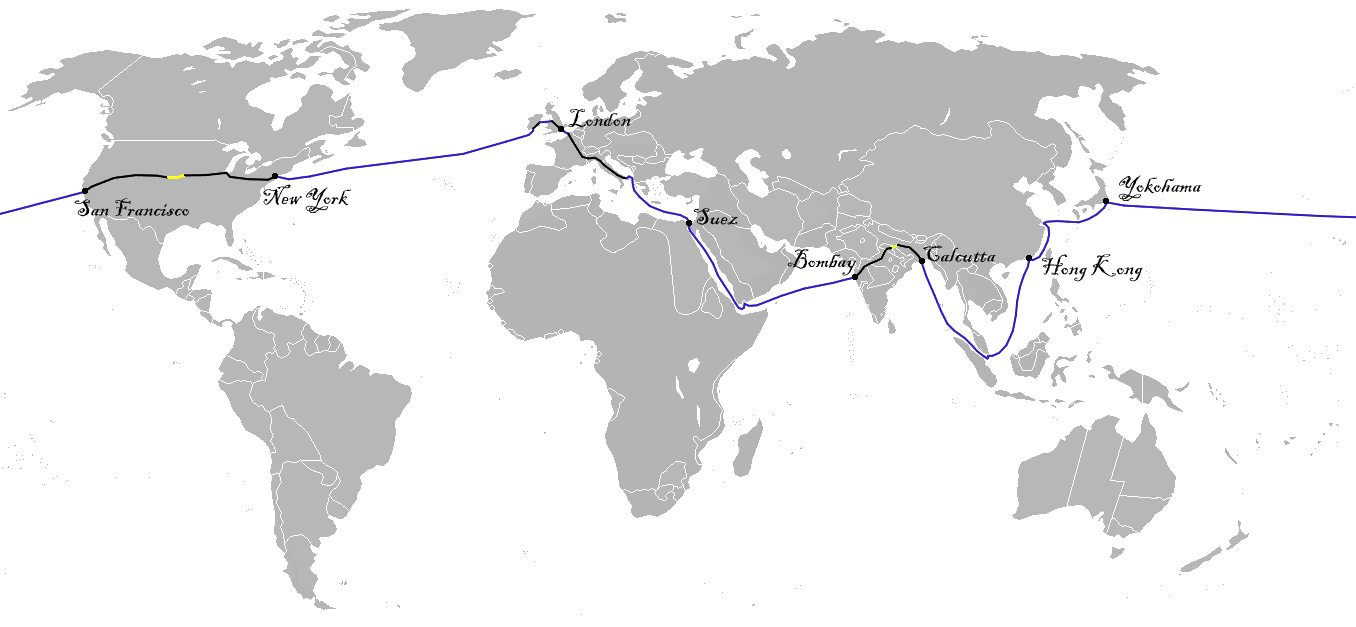
The technological innovations of the 19th century started the age of exploration. With the completion of the first Transcontinental Railroad in the United Sated and the opening of the Suez Canal, it may it possible for people to travel around the world. The theme of this novel is the newborn possibility and freedom that rose from the technological boom. For this reason, the author tries to imply that nothing is impossible if you try. For instance, despite all of detective Fix’s plans that end up interfering the journey, Mr. Fogg ends up making it back to Liverpool in time.


Around the World In Eighty Days


Around the World in Eighty Days was first published in 1873 by author Jules Verne.